Colombia

Armed conflict has been prevalent in Colombia for over fifty years. And one of the strongest institutions resisting this conflict has been the Catholic Church. In 2016, the government of Colombia reached a peace agreement with one major guerilla group, the Revolutionary Armed Forces of Colombia, and in 2017 it took major steps toward peace with another, the National Liberation Army. The Catholic Church has been a major actor in both of these processes. CPN has been involved in accompanying the Colombian Church in the effort for peace and reconciliation, and in bringing its wisdom and insight on peacebuilding to Catholic actors in other parts of the world.
CPN involvement with Colombia has included:
- The international conference "Peacebuilding, Mining, and Integral Human Development," held in 2025 at Javeriana University in Bogotá, and which included 58 people from around the world, including the Philippines, the UK, Vatican City, Canada, the US, Mexico, Guatemala, Colombia, Ecuador, Peru, Brazil, and the Democratic Republic of the Congo.
- CPN co-sponsored the 2023 panel event "Overcoming Violence in Wounded Societies: Perspectives from the Colombian and Kenyan Truth Commissions," featuring Francisco de Roux, SJ, former chair of Colombia’s Truth Commission and Tecla Namachanja Wanjala, former vice and acting chair of Kenya’s Truth, Justice and Reconciliation Commission.
- In 2017 and 2018, CPN co-sponsored two conference events with the Holy See Mission to the UN examining the Colombian Peace Agreement.
- In 2017 and 2011, CPN participated in the biennial Congreso Nacional de Reconciliación held in Colombia.
- In 2012, CPN hosted a session for seventeen Colombian bishops, including the current and past leadership of the Episcopal Conference of Colombia, involved in the peace process.
- In 2007, CPN's fourth annual international conference on Catholic peacebuilding was held in Bogotá, with the theme "Creating a Climate of Reconciliation: Opening Space for Truth, Justice and Reparation."
Events
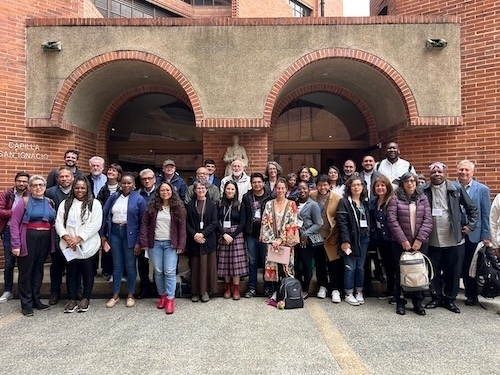
Peacebuilding, Mining, and Integral Human Development
June 10-13, 2025
Bogotá, Colombia
In a number of the world’s most intractable conflicts, the Catholic Church has played and is playing a major role in peacebuilding. In many areas, this peacebuilding work is becoming increasingly intertwined with issues around resource extraction, illicit economies, and the search for modes of integral human development that do not induce environmental violence, human rights violations, breakdowns in social cohesion, backsliding in peace processes, or disempowerment of already marginalized peoples. These new circumstances are presenting new and complex challenges for achieving sustainable peace.
Much of this peacebuilding work by the Catholic community is unheralded, under-resourced, and under-analyzed. While the Church’s peacebuilding work in some conflict situations has been well documented, Catholic peacebuilders from different countries rarely have the opportunity to compare notes on lessons learned and best practices with their counterparts in other countries and scholars. Moreover, in many cases, the Church’s peacebuilding work could be enhanced if it were based on more strategic and less ad hoc and reactive approaches. The sponsors of this project have been deeply engaged in a variety of ways with the Church’s peacebuilding efforts for many years, and the purpose of this conference was to foster this kind of networking and mutual learning with regard to the unique challenges of peacebuilding, mining, and integral human development.
"Overcoming Violence in Wounded Societies: Perspectives from the Colombian and Kenyan Truth Commissions"
Keough School of Global Affairs Washington, DC Office, University of Notre Dame
April 12, 2023
How can societies grapple with the legacies of conflict and human rights violations? How might they overcome traumatic cycles of ongoing violence? And what can spiritual traditions teach them about moving forward toward a better future? This panel examined these questions with: Rev. Francisco de Roux, former chair of Colombia’s Truth Commission; Tecla Namachanja Wanjala, former vice and acting chair of Kenya’s Truth, Justice and Reconciliation Commission; and two Colombian attestants to the armed conflict. The panel was moderated by Leslie Wingender, Director of Peacebuilding for Humanity United.
Resources and Documents
Development Extractives Land rights Peace Processes Transitional Justice and Reconciliation Colombia