Extractives
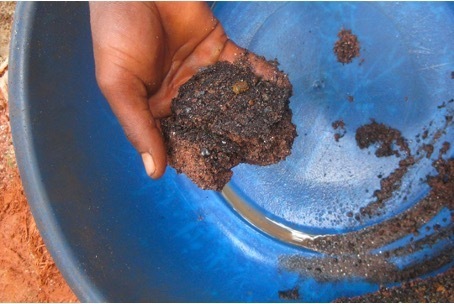
In 2014, CPN began work focused on natural resource extraction and land use, issues of great importance to all of the global locations where CPN has been involved. Conflict and violence have been frequent as parties have struggled for control of the wealth offered by these resources, laborers have faced exploitation and danger, and environmental harm has occurred leading to greater social instability. CPN has attempted to map Catholic engagement on these issues. And in Fall 2015, CPN sponsored a colloquium to invite scholars and experts to craft a strategy for generating theological and ethical study of these issues through the lens of peacebuilding and Catholic Social Teaching. Based on the work of that colloquium, CPN is in the process of executing a long-term research plan to integrate existing research on extractives, relate it to the practices of the Catholic community, and consider it from a peacebuilding perspective. The initiative has included:
- Between 2013 and 2018, CPN participated in a series fo Days of Reflection hosted by the Vatican with mining company executives, faith leaders, and representatives from communities and grassroots organizations in mining-affected areas.
- In 2019, CPN hosted a colloquium on Catholic peacebuilding and mining at the University of Notre Dame. Video of the keynote panel is available.
- An edited volume, Catholic Peacebuilding and Mining: Integral Peace, Development, and Ecology (Routledge, 2022).
- Collaborated on the 2024 symposium Conflicts in Africa in the Context of the Exploitation of Natural and Mining Resources, organized by the Symposium of Episcopal Conferences of Africa and Madagascar.
Catholic Approaches to Mining
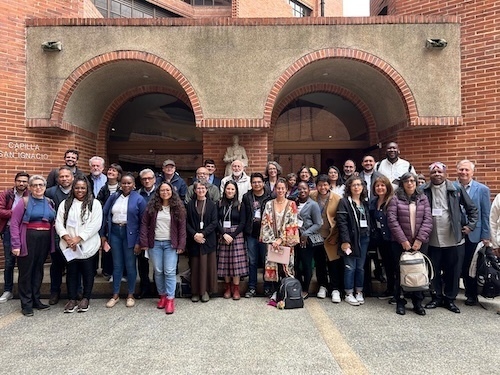
Through 2024-25, with the Laudato Si' Research Institute, Campion Hall, Oxford University, CPN conducted a series of workshops with global Catholic actors engaged on mining issues to gather input for a guidance document on the Catholic Church and mining, culminating in the conference "Peacebuilding, Mining, and Integral Human Development" in Bogotá, Colombia, in June 2025. This initiative has led to several projects and products:
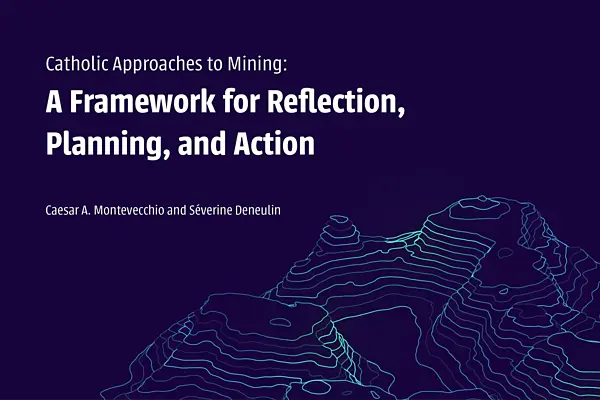
- Catholic Approaches to Mining: A Framework for Reflection, Planning, and Action, co-published with the Holy See Dicastery for Promoting Integral Human Development, Caritas Internationalis, and the University of Notre Dane's Kroc Institute for International Peace Studies, part of the Keough School of Global Affairs. Available in Spanish, French, English, Italian, and Portuguese.
- Catholic Approaches to Mining: Cases of Impact, a set of eight case studies, written by local practitioners, about successful examples of engagement by members of the Catholic community in different mining-affected countries. Available in Spanish, French, English, and Portuguese.
- In 2025, published a policy brief for the Keough School of Global Affairs Policy Brief Series: Standing with the Vulnerable: Catholic Accompaniment of Mining-Affected Communities.
- Popular and academic publications:
- "The Catholic Church and Mining: Types of Responses," Sustainability (2025)
- "Subsidiarity: A Central Principle for Justice, Peace, and Sustainability in Mining," The Journal of Social Encounters (2023)
- "Mining and Conflict: What Can Catholic Peacebuilders Do About It?," Religion in Praxis Blog (December 6, 2022)
- "Catholic Peacebuilding and Mining," Peace Policy: Solutions to Violent Conflict, Kroc Institute for International Peace Studies, University of Notre Dame (February 2022)
- "Untangling Renewable Energy from Extractivist Development," Dignity and Development Blog, Keough School of Global Affairs, University of Notre Dame (June 16, 2021)
Events
From Michiana to the Congo: How Data Centers are Worsening Mining-Related Conflict
September 17, 2026
The rush for AI data center construction is increasing the already growing rush for critical minerals. As a result, data centers not only raise social, economic, and environmental questions for the local areas where they are built, they raise dire questions for the areas in the Global South where materials necessary for their advanced technology are mined. This panel examined this complex dynamic with a conversation about data center advocacy in the Michiana region, recent Catholic teaching on AI ethics and data centers, particularly in Pope Leo XIV’s Magnifica Humanitas, and realities in the Democratic Republic of the Congo related to critical minerals and violent conflict.
Peacebuilding, Mining, and Integral Human Development
June 10-13, 2025
Bogotá, Colombia
In a number of the world’s most intractable conflicts, the Catholic Church has played and is playing a major role in peacebuilding. In many areas, this peacebuilding work is becoming increasingly intertwined with issues around resource extraction, illicit economies, and the search for modes of integral human development that do not induce environmental violence, human rights violations, breakdowns in social cohesion, backsliding in peace processes, or disempowerment of already marginalized peoples. These new circumstances are presenting new and complex challenges for achieving sustainable peace.
Much of this peacebuilding work by the Catholic community is unheralded, under-resourced, and under-analyzed. While the Church’s peacebuilding work in some conflict situations has been well documented, Catholic peacebuilders from different countries rarely have the opportunity to compare notes on lessons learned and best practices with their counterparts in other countries and scholars. Moreover, in many cases, the Church’s peacebuilding work could be enhanced if it were based on more strategic and less ad hoc and reactive approaches. The sponsors of this project have been deeply engaged in a variety of ways with the Church’s peacebuilding efforts for many years, and the purpose of this conference was to foster this kind of networking and mutual learning with regard to the unique challenges of peacebuilding, mining, and integral human development.
Resources and Documents
Also visit the following sites for Church organizations specifically dedicated to working on issues of extractives in CPN partner areas.
Iglesias y Minería: Churches and Mining is an ecumenical group made up of lay groups, religious congregations, and bishops and pastors addressing issues around mining and justice.
REPAM: Red Ecclesia Amazonica, a cooperative commission of bishops' conferences in the Amazon basin that works on issues of environment and natural resources.
Ecclesial Network of the Congo Basin Forest: A cooperative of regional and national justice and peace commissions of the Symposium of the Episcopal Conferences of Africa and Madagascar.
Alyansa Tigil Mina: Composed of Non-Government Organizations, People’s Organizations, Church groups and academic institutions, Alyansa Tigil Mina is both an advocacy group and a people’s movement, working in solidarity to protect Filipino communities and natural resources that are threatened by large-scale mining operations.
Justice in Mining: A global network of Jesuit social centers and organizations working on socio-environmental justice in areas impacted by extractive-related conflict.